
ENERGY AND NUTRITION FROM microALGES
Chlorella
vulgaris
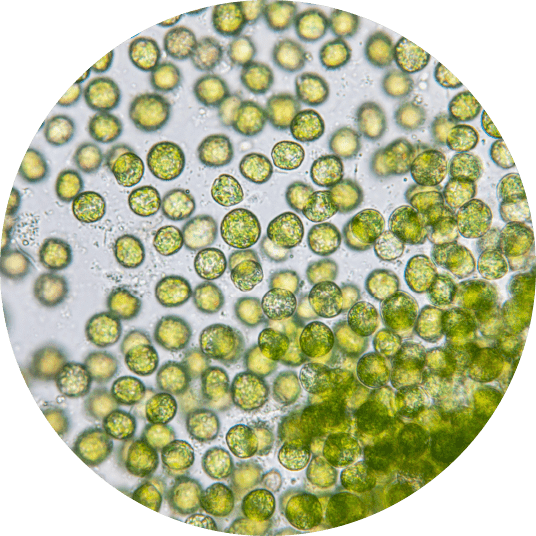
Chlorella sp. it is a unicellular green alga, spherical in shape and devoid of flagellum. It is one of the first life forms appeared on Earth about 3.5 billion years ago.
For its replication it requires light, carbon dioxide and water with a small amount of minerals dissolved in it. Chlorella sp. normally grows in freshwater habitats, particularly in photobioreactors.
Research, development and production
of chlorella
In our R&D department we are developing new pharmaceutical products and food supplements from algae. The constant research in cooperation with the best Universities, led to the development of a little-known field with great potential.
The patented closed circuit technology without contact with air allows to obtain 100% organic products, as opposed to the open ponds technology, which are usually contaminated by external agents.
In terms of nutrients:
- Contains up to 58% vegetable protein, almost as much as the protein content of eggs and milk
- It is rich in beta-carotenes (antioxidants, important for eyesight, for bone growth, for cell growth and differentiation, for teeth health), of which it has a concentration 10 times higher than that of carrots
- It is one of the few vegetable sources of vitamin B12, a characteristic that makes it a valid alternative for vegans and vegetarians who have nutritional deficiencies of the aforementioned vitamin
- Also contains all the other vitamins of groups B, A, C and E
- It is rich in a wide range of mineral salts such as magnesium, potassium, calcium, chromium, copper, iodine, potassium, selenium, zinc, phosphorus
- contains iron, important for the construction of red blood cells and for a healthy immune system, in a quantity 10 times higher than the most common foods rich in this mineral